Summary
The Caio Terra ankle lock is a refined variation of the straight ankle lock that uses the hips, core, and angle of pressure to apply the submission.
Popularized by one of the most technical Brazilian Jiu-Jitsu practitioners in history, Caio Terra, known for his technical mastery and attention to detail.
His approach to the ankle lock reflects his broader philosophy of efficiency and control in grappling.
This article explains what the Caio Terra ankle lock is, why it is so effective, and how it fits into modern BJJ.
Key Takeaways
- The Caio Terra ankle lock relies on positioning and leverage rather than strength.
- Small details like foot placement and hip angle make a major difference.
- It is an effective leg lock submission in both Gi and No-Gi grappling.
Who Is Caio Terra?
Caio Terra is widely regarded as one of the most accomplished and technical Brazilian Jiu-Jitsu competitors of his generation. A multiple-time world champion across major organizations, he built his legacy through precision, discipline, and a deep understanding of positional control rather than relying on size or strength. Known for his methodical approach, Terra consistently showcased how efficiency and timing could overcome physical advantages during his championship runs.
The Caio Terra ankle lock reflects this philosophy. Instead of falling back and pulling with force, the technique emphasizes staying upright, controlling distance, and applying pressure through alignment and positioning. This refined approach makes the ankle lock harder to defend, more consistent at higher levels, and a staple example of how technical details can elevate a traditional submission.
Why This Ankle Lock Is So Effective
The effectiveness of the Caio Terra ankle lock comes from eliminating space. By controlling the foot tightly and aligning the body correctly, the pressure is directed into the ankle joint with minimal effort.
Rather than cranking backward, the submission works through controlled extension and rotation. This makes it harder for opponents to defend using common counters like booting the foot or spinning.
Key Details That Define The Caio Terra Ankle Lock
- Foot Position: The opponent’s foot is secured tightly under the forearm with the wrist positioned near the ankle bone. This placement ensures pressure is applied directly to the joint rather than the foot itself.
- Arm Structure: The arms stay compact and connected to the body. Instead of pulling with the biceps, the forearms act as a lever supported by the torso.
- Hip Angle: A slight angle away from the opponent helps align the pressure correctly. This angle also limits the opponent’s ability to rotate or escape.
- Upper Body Posture: Maintaining an upright posture keeps pressure consistent and prevents space from opening during the finish.
Common Entries Into The Caio Terra Ankle Lock
1) From The De La Riva
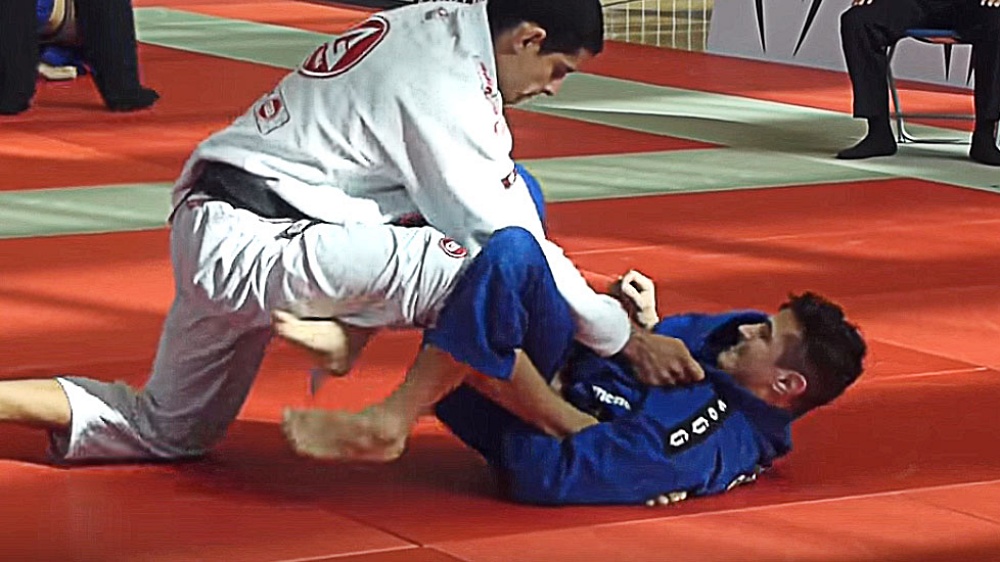
When your opponent steps in, controlling the foot becomes the key to entering the ankle lock. By securing the ankle and sitting into position, you can off-balance your opponent while keeping their weight forward. This creates a clean pathway to transition into the ankle lock without rushing. The focus is on timing and control rather than speed, allowing you to enter the position safely and maintain strong leg positioning before applying the finish.
2) From The Single Leg X
This position provides natural control of the leg and makes transitioning into the ankle lock efficient and controlled.
3) During Guard Retention
As opponents attempt to pass, their exposed leg can be captured and transitioned into the submission.
Common Mistakes To Avoid
Despite it being a somewhat straightforward technique, many practitioners often encounter a few common mistakes when attempting the Caio Terra Ankle Lock:
- Leaving space between the arms and the opponent’s foot.
- Pulling backward instead of engaging the hips.
- Failing to control the opponent’s knee line.
- Rushing the finish without proper alignment.
- Losing posture during the attempt often results in unfavorable positions.
Attention to detail is what makes this variation effective. Remember, don’t rush it.
The Caio Terra Ankle Lock And The Valente Lock
Traditional straight ankle locks often rely on falling backward and pulling with the arms to generate pressure. The Caio Terra ankle lock and the Valente lock take a different approach by keeping you more upright and applying pressure through proper alignment of the hips, legs, and upper body.
By focusing on positioning rather than force, these variations reduce strain on the arms and make the finish more reliable against experienced opponents. This control-first method improves balance, limits defensive reactions, and increases consistency, especially at higher levels of grappling.
How To Train The Caio Terra Ankle Lock
This submission is best developed through slow, technical drilling. Focus on control before attempting to finish.
Positional sparring from leg entanglements helps reinforce correct angles and posture.
FAQs On The Caio Terra Ankle Lock
Q: Is The Caio Terra Ankle Lock Legal In Competition?
A: Yes. The straight ankle lock variant is legal in most Gi and No-Gi rule sets.
Q: Does This Ankle Lock Work Without Strength?
A: Definitely. Most, if not all, techniques in BJJ utilize leverage over strength. Proper positioning matters more than strength.
Q: Is This Ankle Lock Effective At Higher Levels?
A: Yes. The ankle lock remains highly effective even at advanced levels. As leg entanglements have become more refined and widely used at higher levels, a well-executed ankle lock continues to be a reliable finishing option even against experienced opponents.
Final Thoughts
The Caio Terra ankle lock is a prime example of how technical refinement can elevate a fundamental submission. By focusing on control, alignment, and efficiency, this approach makes the straight ankle lock more reliable and less dependent on strength. For practitioners looking to improve their leg lock game with precision and consistency, understanding this variation offers long term value in Brazilian Jiu-Jitsu.
You may also like: