Summary
The knee is one of Muay Thai‘s most powerful and versatile close-range weapons — but like all close-range techniques, its effectiveness depends entirely on how well it is set up. Landing a clean knee requires the ability to close distance safely, position the body at the right angle, and create the moment of vulnerability that makes the strike possible. This article covers the three primary methods for setting up the Muay Thai knee: the clinch, which combines footwork and postural control to create the most reliable knee-landing environment; footwork and angle-cutting used outside the clinch to close distance and create offensive positions; and strikes used to distract, occupy, and misdirect the opponent’s guard before the knee arrives. Each method is explored with specific set-up variations — from clinch footwork and the break timing, to angle-cutting leg kicks, double jabs, and the full range of jumping and switch-step knee variations. As Muay Thai World Champion and Evolve MMA instructor Chaowalit Jocky Gym puts it, “The knee does not score because it is powerful — it scores because of what comes before it. Every great knee in Muay Thai is the result of footwork, positioning, and timing that the opponent never fully saw coming. Set it up correctly, and the knee takes care of itself.” Whether you are a beginner exploring the knee for the first time or a more experienced fighter looking to add structure to your close-range game, this guide gives you the tools to make the knee a reliable weapon in your arsenal.
Key Takeaways
- The knee is a close-range weapon that cannot be used without first closing distance, and how you close that distance determines whether the knee lands cleanly or gets countered. Footwork, angles, and hand positioning on the approach are what make the knee available, not the strike itself.
- The clinch is the most reliable environment for landing knees because it combines positional control with striking opportunity. Dominant clinch positioning limits your opponent’s ability to respond while creating the space and angle needed for the knee, making it more effective than attempting the same strike from open range.
- Footwork outside the clinch opens up knee opportunities that the clinch cannot. Angle-cutting, full stepping, and distance manipulation each create different entries to the knee, and developing a variety of these entries makes your knee game significantly harder to read and defend.
- Strikes are the most natural and accessible setups for beginners landing their first knees. A hook draws the opponent’s guard to the side, opening the centreline for a knee. A double jab occupies the hands and eyes while you close the distance. A leg kick forces an opponent to reposition, creating the timing window for a knee as they turn back into you.
- Varying the type of knee, straight, angled, jumping, switch-step, or pop knee, multiplies the difficulty of defending against it. Each variation arrives from a different position and trajectory, and an opponent who has only ever faced straight knees up the middle will be significantly less prepared for a knee coming around the outside or a jumping knee following a clinch break.
- The timing of the clinch break is one of the most underused knee opportunities in beginner training. The moment the clinch separates, both fighters are momentarily in transition, and a jump knee or driving knee timed to that break arrives when the opponent’s defensive structure is at its least organised.
1) The Clinch
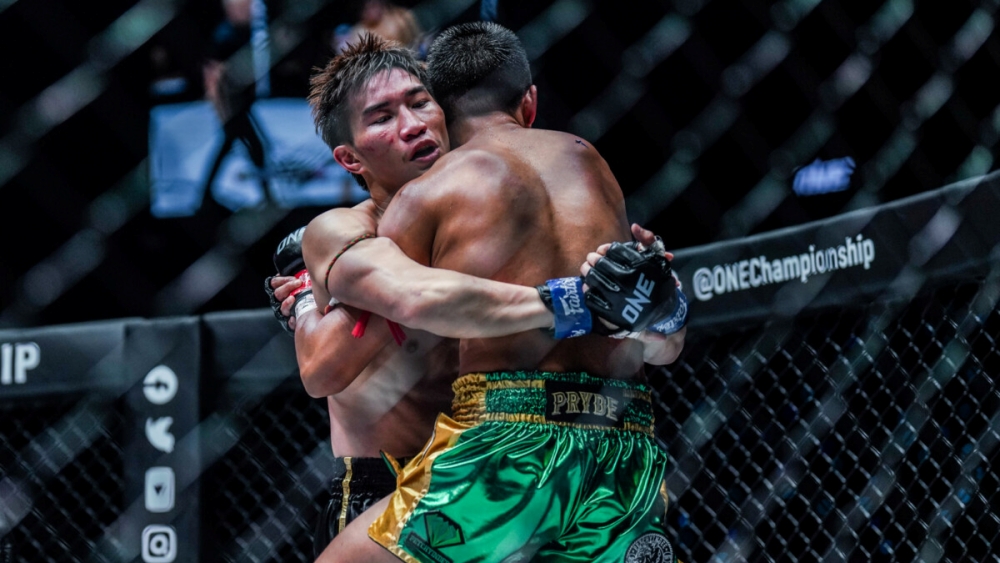
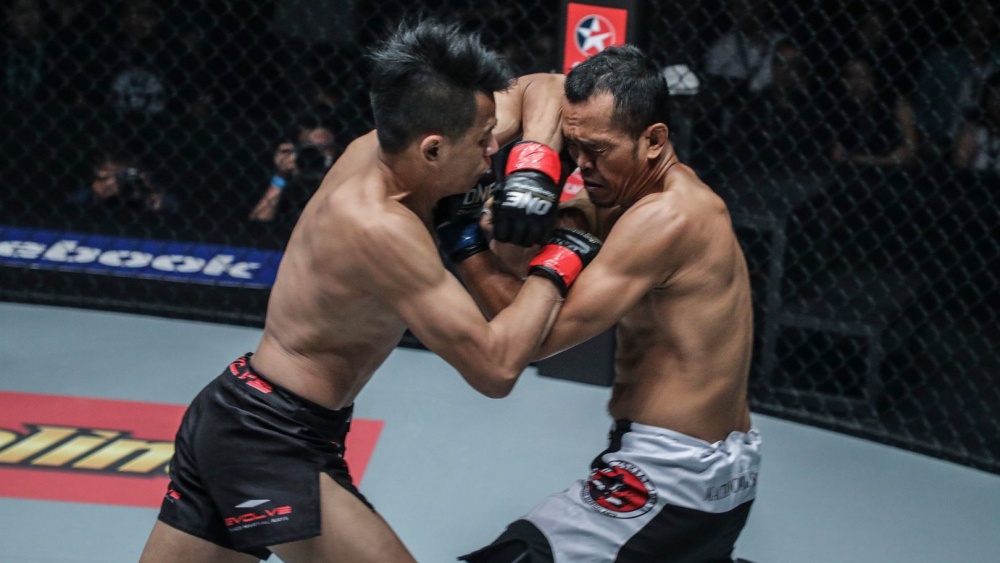
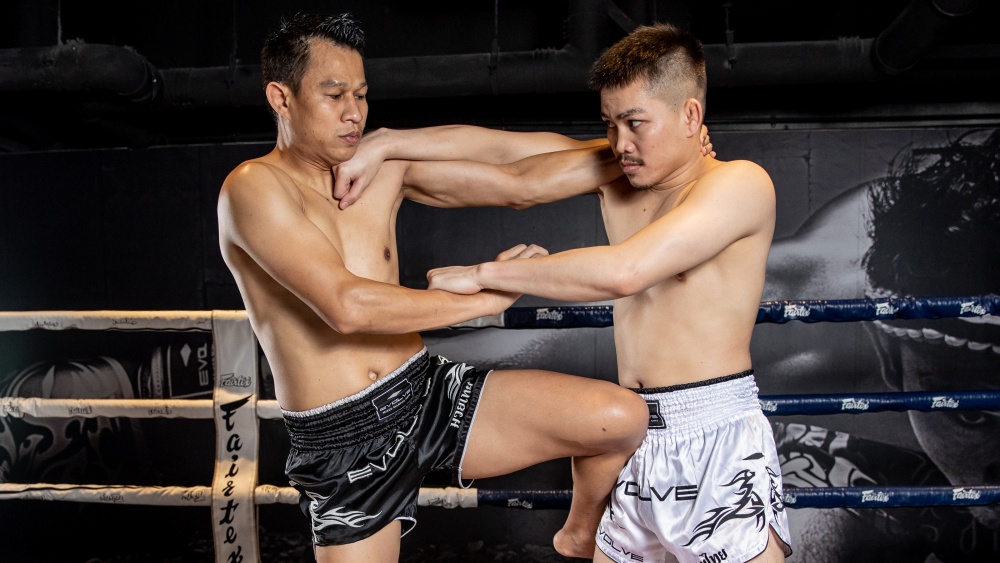
Possibly one of the best ways to utilize and set up the Muay Thai knee is within the clinch. The clinch lends quite easily towards landing knees, and will enable you to utilize both footwork and angles at the same time to land powerful knees. The control within the clinch creates a postural dominance that gives you space for landing the knee while maintaining control over your opponent. Try these set-ups from within the clinch to land your knees.
- From within the clinch, try utilizing footwork to move your partner to a new angle (think of taking a full step back, and turning to face the location that was previously behind you while still maintaining the clinch). As your partner works to step and catch their balance, use that timing to land a knee to the body. Both knees up the middle and knees coming from the outside to your partner’s side are effective here.
- Another way to use the clinch is to use your footwork to step back while maintaining a solid clinch, pulling your partner with you, while still facing the same direction. As they step to follow you forward, try driving back in with the knee up the middle.
- Utilize the break of the clinch. When the clinch is about to break, utilize the timing of the break to drive in with a knee or even a jump knee to close any distance that has been created.
2) Footwork
Footwork can be used to set up the Muay Thai knee, both from within the clinch, as previously discussed, or from outside the clinch, as well. Try these set-ups utilizing footwork.
- Use your footwork to cut an angle on your opponent before stepping back into the knee. Cutting an angle will put you in a better defensive position as you move towards landing a knee. Try pulling your knee up and around your opponent as opposed to a straight knee up the middle. Utilize your hands to post or gain some control of your opponent’s head or shoulder as you work into this knee.
- Use a full step to close the distance and land a knee up the middle. Since knees require close range to be utilized, a full step will cover that range and get you closer to your target. If you are moving straight forward using a full step, be sure to utilize your hands to protect yourself, or by throwing a few offensive strikes on the way towards your opponent.
- Use footwork to play with closing the distance. Playing with different ways of moving to the inside with the knee will help you to cut the distance quickly, leaving you a bit more protected during the process. You’ve likely seen variations of “flying” knees in Muay Thai, and they are fun to play with and experiment with.
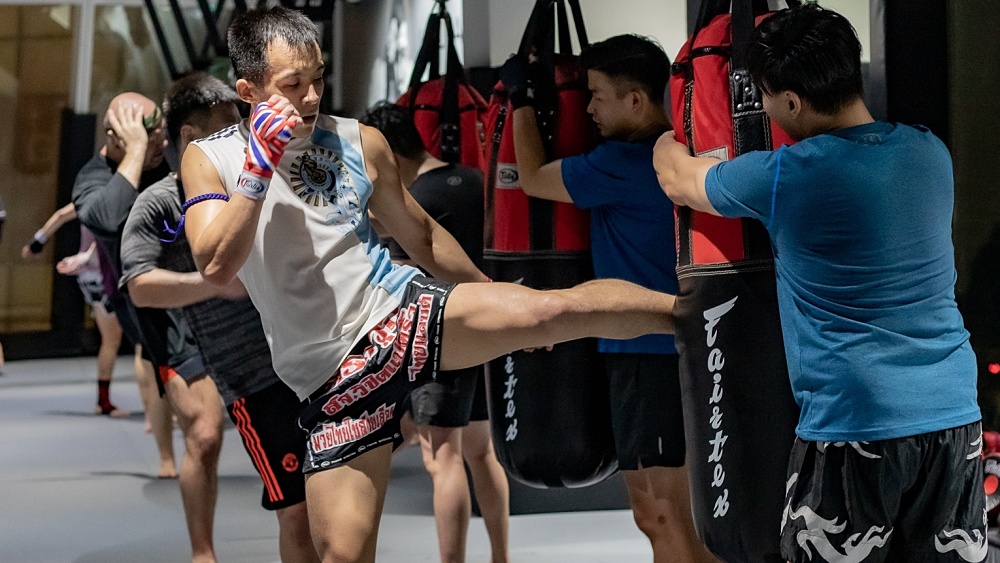
Try a variety of knees, like a full-step knee (take a full step with your back leg and then knee with your lead knee), a jump knee (back knee comes up, then jumps into the lead knee), a pop knee (both feet leave the ground at the same time and your back knee is utilized for the strike), or even a switch-step knee (switch your feet simultaneously, then throw the knee from your back knee).
3) Strikes
Using one strike to set up another is a great way to set up any strike in Muay Thai. The knee is no exception. Try utilizing some of these strikes to land knees:
- Hooks: If you are close enough to throw a hook, then you are close enough to throw a knee. Try using the hook (which comes from the side) to set up the knee (which will come from the front). Playing with strikes coming from different angles will help you to distract your opponent and give for the best opportunity to land your strikes.
- Leg kicks: Leg kicks are a great way to set up your knees. Cutting an angle to land a leg kick will most always result in your opponent turning back into you to remove your angle on them. Utilize the moment they turn back into you to drive your knee forward towards your opponent.
- Double Jab: Doubling (or more) up your jab as you move into your partner will keep their hands and eyes distracted as you give yourself time to cut the distance and follow up with a solid rear knee. Target the jabs to the face in order to draw your opponent’s hands up to their face and open up the body for landing your knees.
Whether you choose to utilize footwork, strikes, or even the clinch to bring everything together, the knee is a great strike to start exploring with confidence as you jump into Muay Thai.
Frequently Asked Questions About Setting Up The Muay Thai Knee
Q: Why Is The Knee Considered A Close-Range Weapon And How Does That Affect How I Train It?
A: The knee requires you to be within roughly arm’s length of your opponent to land effectively — significantly closer than punches or kicks, which can be thrown from a step or two outside that range. This proximity requirement means that training the knee in isolation on a bag or in shadow is only part of the work. The more important training is developing the entries — the footwork, the clinch work, the strikes — that get you into knee range safely without being countered on the way in. Beginners who drill the knee strike itself without drilling the approaches will find that the technique works cleanly in drills but fails in sparring, because the approach has not been practised. Training the knee means training the full sequence from distance to contact.
Q: What Is The Difference Between A Knee Thrown From The Clinch And A Knee Thrown From Open Range?
A: From the clinch, you have positional control over your opponent — your arms manage their posture, limit their movement, and create space for the knee. This makes clinch knees more reliable and more powerful, because the opponent’s ability to move away, check, or counter is significantly reduced. From open range, knees require a step or entry to close the distance, which creates a window of vulnerability during the approach. Open-range knees compensate for this with surprise and momentum — a jump knee or a knee off a leg kick creates a different kind of threat that the clinch cannot replicate — but they require more precise timing and more confident approach mechanics to land safely. Both have an important place in a complete knee game.
Q: How Do I Avoid Getting Countered When Stepping In For A Knee?
A: Closing the distance for a knee without getting countered requires a combination of hand activity, angle management, and timing. Using the hands to protect the head or occupy the opponent, throwing jabs, covering the centreline, on the way in, reduces the window for clean counters. Cutting an angle rather than moving straight forward means the opponent’s counter weapons are not pointed directly at you as you arrive. Timing the approach to a moment when the opponent is committed to their own action, a kick, a combination, a weight shift, takes them out of their optimal countering position. None of these elements alone is sufficient; the combination of all three is what makes the approach genuinely safe.
Q: What Is The Most Effective Knee Variation For Beginners To Develop First?
A: The straight rear knee is the most practical starting point for beginners because its mechanics are the most straightforward: weight forward, hip drive up and through the target, lean the upper body back for balance, and it is the most naturally accessible from both the clinch and the full-step entry. Once the rear knee is clean and reliable, the straight lead knee from the clinch is the natural next step. The more dynamic variations, the jump knee, the pop knee, and the switch-step knee, require better balance, timing, and spatial awareness, and are significantly more rewarding to develop once the fundamental straight knee mechanics are solid. Rushing to the jumping variations before the straight knee is reliable typically produces spectacular-looking but unreliable techniques.
Q: How Does Cutting An Angle Before A Knee Change What The Opponent Can Do Defensively?
A: When you approach straight down the centreline for a knee, the opponent is facing you directly — their guard, their hips, and their ability to check or counter are all optimally positioned to respond to your attack. When you cut an angle first, you move to a position where the body is no longer squarely facing you. From the outside angle, the knee arrives from a direction that is harder to check, their counter weapons point away from where you are, and their posture is momentarily compromised as they work to re-establish their facing. The angle-cut knee arriving around the outside to the side of the body — rather than straight up the middle — is the specific combination that takes maximum advantage of this positional disruption.
Q: Why Is The Clinch Break A Valuable Timing Window For The Knee?
A: When two fighters are in the clinch, and the hold begins to separate — either because a referee intervenes, because one fighter pushes the other away, or because the grip naturally loosens — both fighters are in a transitional state. Their arms are moving from clinch position back toward their guard, their feet are adjusting to reestablish stance, and their defensive structure is momentarily at its least organised. A knee timed to fire precisely at the moment of the break — or a jump knee that follows the separation — arrives when the opponent is least prepared to check or avoid it and before they have reset into a solid defensive position. Developing the ability to read the break and fire at that exact moment is one of the higher-value timing skills in close-range Muay Thai.
Q: Can Strike Setups For The Knee Work Against Experienced Fighters Or Do They Only Work On Beginners?
A: The specific mechanics of how a strike sets up the knee, a hook drawing the guard to the side, a double jab occupying the hands while you close distance, a leg kick forcing a repositioning — work at all levels because they exploit genuine biomechanical and attentional limitations, not inexperience. An experienced fighter whose guard has genuinely been drawn to the side by a hook is in exactly the same vulnerable position as a beginner in the same situation. What changes at higher levels is that experienced fighters are better at not being manipulated into those positions — better at maintaining their guard during exchanges, better at reading the leg kick setup, better at recognising the double jab as a distance-closing tool. The solution is not to abandon the setups but to make them less readable — better disguise, better timing, more varied entries, and the patience to use the setup only when the opponent has genuinely been conditioned to expect the preceding strike.
Q: How Do I Develop The Hand Control Needed For Clinch Knees?
A: Hand control in the clinch — the ability to manage the opponent’s arms, break their posture, and create space for the knee — is a skill that develops primarily through clinch-specific partner drilling rather than striking drills. Begin with cooperative partner drilling, where both partners take turns establishing clinch positions and practising the footwork and postural control variations described in this article. As your understanding of the positions develops, introduce more resistance — where the partner actively works to maintain their posture and avoid the knee — and then progress to live clinch sparring. Specific drills like single-collar tie work, double-collar tie work, and arm-control entry sequences are the most direct way to develop the individual components of clinch hand control. The clinch is one of the most technically rich areas of Muay Thai, and the time invested in developing it pays dividends across every aspect of your close-range game.
You may also like: